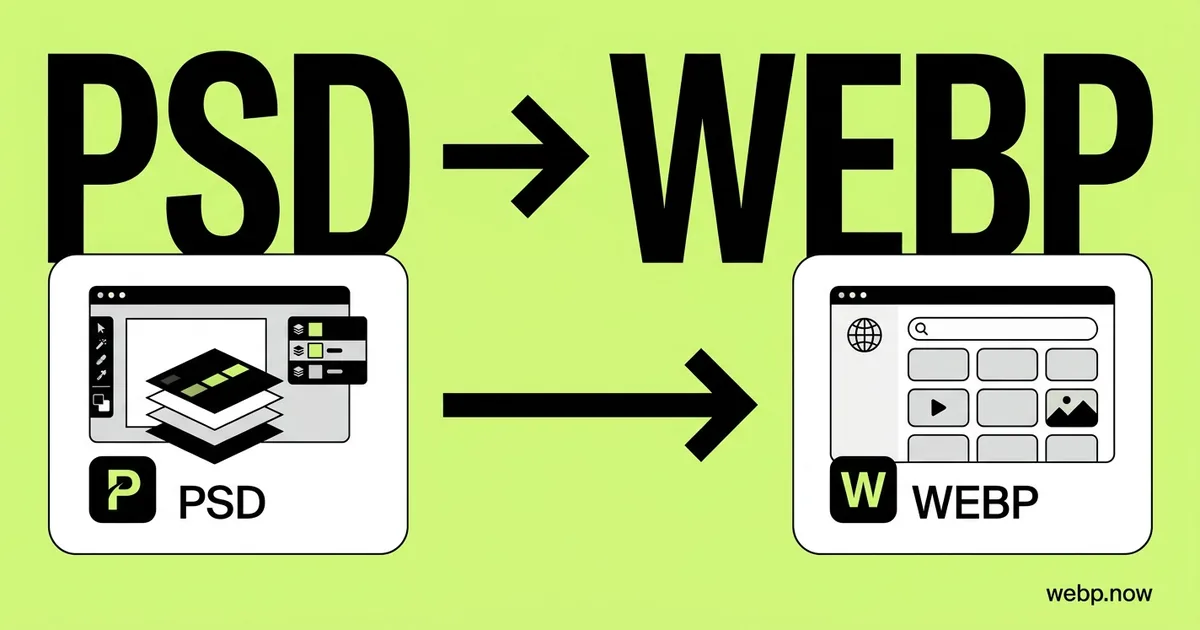
Convert PSD to WebP Online
Turn PSD files into WebP images that load fast and render in every browser.


Drop your PSD file here
or click to select
How PSD to WebP works
Upload PSD
Drag & drop or click to select your PSD file.
Choose Options
Adjust quality, size, or other output settings if needed.
Download WebP
Click Convert and your WebP file downloads instantly.
About PSD to WebP conversion
PSD is adobe photoshop document. PSD is a working file, not something you publish. Flattening to WebP produces the deliverable — typically a fraction of a percent of the source size.
WebP is the default currency of fast web pages — smaller than JPEG at the same visual quality, smaller than PNG while keeping transparency, and supported by every browser in use. In practice that means a page that loads faster on mobile, a better Largest Contentful Paint score, and less CDN bandwidth — for the same picture. PSD files are often 10-100x larger than WebP — every layer is stored separately, so this is usually the single biggest weight saving available on a page built from them.
Layers, masks and adjustments are flattened on the way to WebP and cannot be recovered. Keep the PSD as the editable master. WebP tops out at 16383 pixels on either edge, so anything larger is scaled to fit; for the vast majority of web work that ceiling is nowhere near a constraint.
Where WebP comes from
WebP was released by Google in September 2010, built on the intra-frame compression of the VP8 video codec Google acquired with On2 Technologies. Lossless mode (VP8L) and alpha transparency arrived in 2011, animation in 2012. Adoption stalled for most of a decade because Safari refused to ship it, so sites had to serve fallbacks anyway. That ended in September 2020 when Apple enabled WebP in Safari 14, macOS Big Sur and iOS 14 — overnight the format became genuinely universal in browsers. Today Next.js, Cloudflare, Cloudinary, imgix, WordPress and Shopify all emit WebP by default, which is why so many images saved from the web now land on disk as a .webp file.
PSD vs WebP at a glance
| PSD | WebP | |
|---|---|---|
| Compression | Lossless RLE or ZIP per layer | Lossy VP8 or lossless VP8L |
| Transparency | Full alpha plus layer masks | Full 8-bit alpha in both modes |
| Animation | Timeline frames supported | Native animation support |
| Colour depth | 8-bit, 16-bit and 32-bit per channel, CMYK, Lab | 8-bit per channel, sRGB |
| Where it opens | Photoshop and a handful of compatible editors | Every current browser; patchy in desktop applications |
| Typical file size | Often 10-100x larger than webp — every layer is stored separately | The baseline |
Real-world workflow — Developer rebuilding an image-heavy page
- Collect the PSD source files — often hundreds of them in one folder
- Batch-convert to WebP at quality 82 with metadata stripped
- Resize on the way out to the largest size the layout actually displays
- Wire them into a
element with a JPG fallback for legacy clients - Ship it and watch the page-weight and Core Web Vitals numbers move
Recommended conversion settings
| Use case | Settings |
|---|---|
| Photographs and hero images | Quality 80-85 — visually lossless, roughly a third of JPG's weight |
| Logos, icons and line art | Lossless mode — no fuzz around hard edges |
| Thumbnails and list images | Quality 70-75, resized to the display size first |
| Images with transparency | Either mode keeps full 8-bit alpha; lossy is far smaller |
| Archival or re-editable copies | Keep the original — WebP is a delivery format, not a master |
Where will your WebP file open?
| Platform | PSD | WebP |
|---|---|---|
| Chrome / Edge / Firefox | ✗ | ✓ |
| Safari 14+ / iOS 14+ | ✗ | ✓ |
| Windows Photos | ~ | ✓ |
| macOS Preview & Quick Look | ✓ | ✓ |
| Adobe Photoshop | ✓ | ~ |
| Microsoft Office 2021+ | ~ | ✓ |
| Email clients (Outlook, Gmail) | ~ | ✗ |
| Social media uploaders | ✗ | ~ |
| Print & prepress (RIP) | ✓ | ✗ |
When to convert PSD to WebP
These are working files, not deliverables. A PSD stores every layer, mask, adjustment and smart object separately so the edit stays live, which is why it is routinely a hundred times the size of the image it produces — and why virtually nothing outside its own editor will open one.
Flattening to WebP produces the publishable output: small, web-ready and openable by anything. It is the last step of a design workflow, turning the file you worked in into the file you ship.
Layers, masks and adjustments are flattened and cannot be recovered from the WebP, so keep the source as your editable master. Large PSB canvases may exceed WebP's 16383-pixel limit, in which case the image is scaled down to fit.
PSD to WebP tips
- Quality 80-85 is the sweet spot for photographs — visually indistinguishable from the original at normal viewing sizes, and roughly a third the weight of the equivalent JPG.
- Use lossless WebP for logos, icons, screenshots and line art. Lossy compression puts visible fuzz around hard edges and text.
- Convert from the highest-resolution PSD you have and let the resize option produce the display size — downscaling before compressing beats compressing then downscaling.
- Strip metadata for web delivery. EXIF blocks can add tens of kilobytes to a file nobody will ever read them from.
- Serve WebP through a
element with a JPG fallback if you still support very old browsers or need images to survive email clients.
Related tools
Formats involved
PSD – Adobe Photoshop Document
WebP – Web Picture Format (Google)
PSD to WebP — frequently asked questions
Related guides & articles
Maybe you wanted something else?
- You want the smallest possible file and can require a modern browser → WebP to AVIF
- You only want to shrink what you already have → Compress WebP
- You need maximum compatibility instead of minimum size → WebP to JPG
- You want to pick a different output format → Image Converter
Related conversions
 JPG → WebP
 PNG → WebP
 HEIC → WebP
 PDF → WebP
 RAW → WebP
 TIFF → WebP
 BMP → WebP
 SVG → WebP
 WebP → WebP
Embed this tool on your website